

You’re allowed to have hobbies you’re bad at
Why doing something just for fun might be exactly what your brain needs

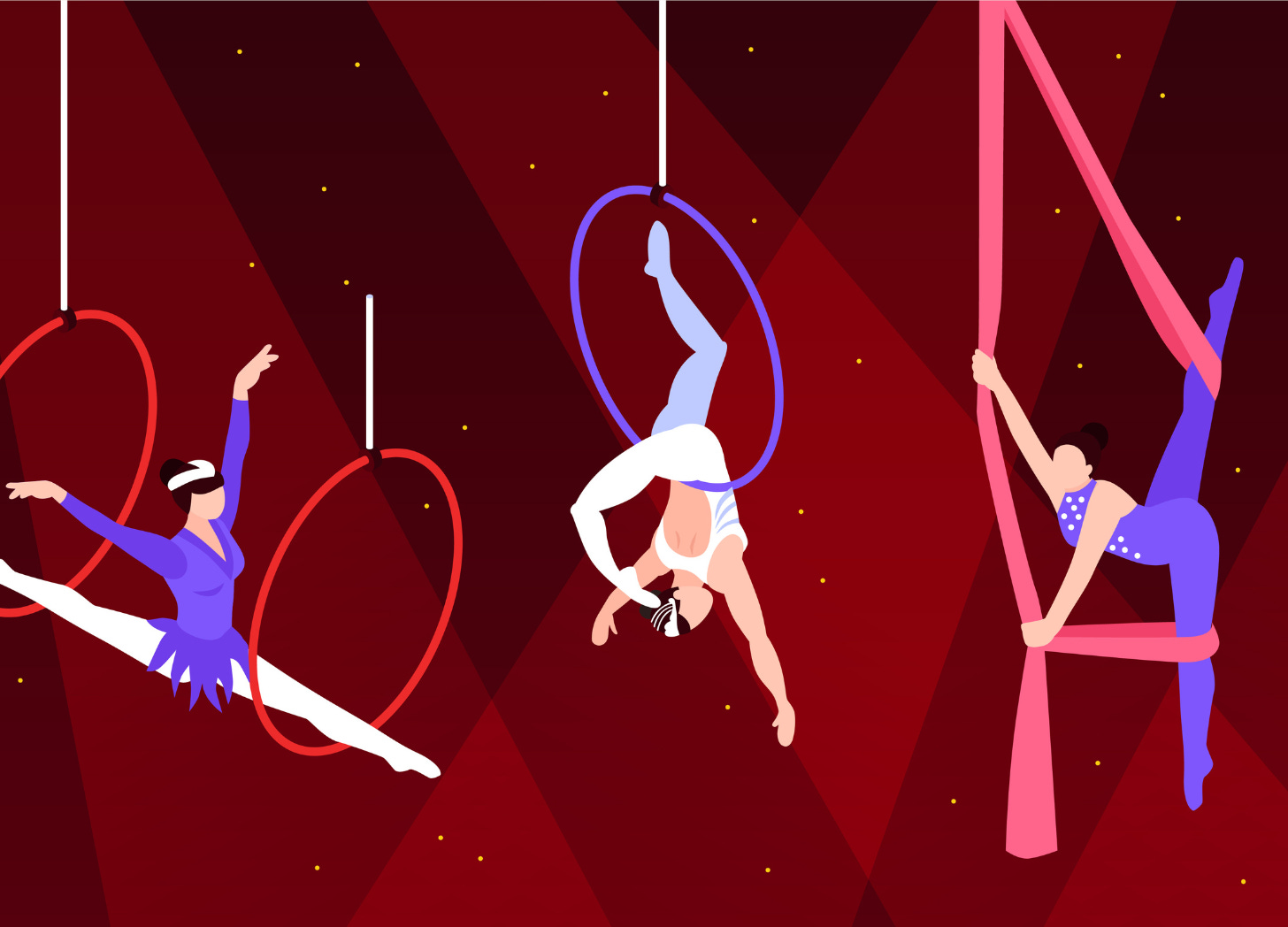
I recently started a new hobby: aerial hoop.
Within two weeks, I had already convinced myself I was the worst person in the class and briefly wondered if that meant I should quit.
I came to aerial hoop after, embarrassingly, googling “active hobbies for women in their 30s” and seeing it near the top of the list.
I wanted to try something completely new that would challenge me mentally and physically. After over a year of barely doing any exercise at all, aerial hoop certainly ticked the challenging box. But more importantly, it looked fun.
After quickly finding a local studio that runs classes, I booked myself in for a taster session.
I LOVED that first session. Pulling myself up into the hoop for the first time was hard work, but managing it gave me a high like that of plunging into cold water or reaching the top of a rollercoaster. I came out of the session beaming and booked myself onto the studio’s four-week “fundamentals of aerial hoop” course straight afterwards.
What I didn’t expect was how quickly an old, familiar voice would show up — the one that insists that if you’re not good at something, you probably shouldn’t be doing it at all.
I was three lessons in, and an uncomfortable reality was presenting itself: Of the group of just four women taking the course, I was, undoubtedly, at the bottom of the class.
My first indication had come earlier, when I arrived at the second lesson, and the instructor greeted me with a surprised “Oh, you’re back!”
I mentally brushed this off at the time. Of course, I’m back. Why wouldn’t I be? I booked a course. I’m doing the course.
But back to that third lesson.
We did the warm-up, as usual. I then watched as the rest of the group set up their phone stands by their hoop, so they could film themselves (or take photos?) in each new position. Presumably so that they could watch it back and see where they needed to improve for next time. Or keep it as proof of their achievement.
This is what you should be doing. The pesky inner voice told me. You’re not taking it seriously enough. That’s why you’re no good.
At one point, I received a faint bit of praise from the instructor for the way I mounted the hoop. I was inwardly ecstatic, but quickly ruined the moment by getting my lefts and rights mixed up and ending up in such a tangle that she had to help me back out of the hoop.
“I manage to do everything in the least elegant way possible,” I joked with a self-deprecating eye roll.
She laughed awkwardly. There was no reassurance.
Toward the end of class, the instructor introduced a new position: hanging upside down from the hoop. She made it look effortless, but I was terrified. I looked to the other women for confirmation that this was impossible, and a ridiculous ask for complete beginners. They, however, were nothing but excited by it and how good it looked. They couldn’t wait to get pictures of themselves in the position. I felt vaguely nauseous and thought seriously about how bad the injuries would be if I were to slip from the hoop and fall neck-first onto the mat below.
I re-mounted the hoop. I sat there for a few moments, gathering my courage, watching the other three women manoeuvre themselves into the position with ease and then sliding out of it with equal grace.
I tried, I really did.
But when I got to the point of leaning back and putting my legs up on the hoop, a light-headedness which I recognised, from experience, as the beginning of an anxiety attack, began to take hold. The instructor came over and tried to support me into the position, but, knowing my own limitations, I firmly told her I couldn’t. Not today.
Her disappointment was clear, and I understood it. I was disappointed in myself.
Instead of coming away beaming, as I had done after my first lesson, I felt heavy and defeated, questioning whether I should be doing this when I was so obviously no good at it.
And then a small but important switch flicked in my brain.
I remembered the reasons I wanted to do it in the first place. None of them had anything to do with being good or looking good. I wanted to challenge myself. I wanted to get fit and strong again after so long of fertility treatment making my body feel like a fragile, delicate thing. I wanted to do something that felt fun in a childlike way, and aerial hoop appealed to that part of my brain because, as a child, I loved gymnastics and climbing up and down things, pretending I could fly and leaping around like a monkey.
Why had I so quickly forgotten this and defaulted to a mindset of performance and perfection? As though every hobby was a measure of my worth?
Partly, I think, it was to do with the atmosphere of the class itself, fostered by the instructor. But mainly, I think it’s a side effect of living in a culture that promotes hustle, hacks and optimisation above all else. Even a casual scroll on Instagram can leave you with the impression that something is only worth doing if you can master it in a matter of weeks — and look perfect while doing it.
It’s not just aerial hoop, a type of fitness class that perhaps attracts people aspiring to a certain type of aesthetic, where I’ve noticed the if you’re not good at something, it’s not worth doing mentality creep in.
I saw it at a recent ‘sip ‘n’ paint’ evening class I did with my husband, Sam. Neither of us was particularly good at it, but that was fine by us; we weren’t there to be good, we were there to have fun. We assumed that, at a painting class with the word ‘sip’ in the title, that’s what everyone else was there for, too.
We were surprised to see that during the first break, people wandered around comparing paintings — favourably or unfavourably — and that by the start of the second half, the girl sitting next to us, who had been lamenting that she was “rubbish”, had left the class and abandoned her painting altogether.
I’ve felt it at some of the (many) book clubs I’ve attended over the past year, when, instead of it feeling like a flowing discussion between people passionate about stories, it felt more like a showcase for clever opinions. I often left feeling like I was the only one who hadn’t prepared a thesis statement in advance.
It’s part of the reason I started my Silent…But Social book club. I wanted a space where reading could simply be enjoyed, with no pressure to perform clever analysis or arrive with the “right” interpretation. Just people, books, and the quiet pleasure of shared reading.
I’m not saying that striving to be good at something isn’t worthwhile. But I don’t think it should be the only reason to take up a hobby.
Not being good at something should never be a reason not to do it.
The more I thought about it afterwards, the more convinced I became that we need hobbies that exist completely outside the realm of performance.
Hobbies that are allowed to be messy. Slow. Imperfect. Hobbies that exist simply because they bring us a little joy.
Here are a few reasons to try something new — even if you’re terrible at it:
It nudges you outside your comfort zone. Growth rarely happens in the places that feel easiest.
It introduces you to people you wouldn’t otherwise meet. Shared awkwardness is surprisingly good for connection.
It builds confidence. When you allow yourself to be new at something, your brain learns that discomfort isn’t danger.
It gives your mind a break from productivity culture. Not everything you do needs to be optimised, monetised, or improved.
📝Journal prompts:
What is something I’ve secretly wanted to try, but avoided because I might not be good at it?
What would it look like to approach it with curiosity instead of expectation?
After all, joy was never supposed to be something we had to earn through competence.
Until next time,
Jess
P.S. If you’ve recently tried something new just for fun, I’d love to hear about it.
"Not being good at something should never be a reason not to do it." - agree with this so much! Loved reading today's post!!